The Temple of Faces
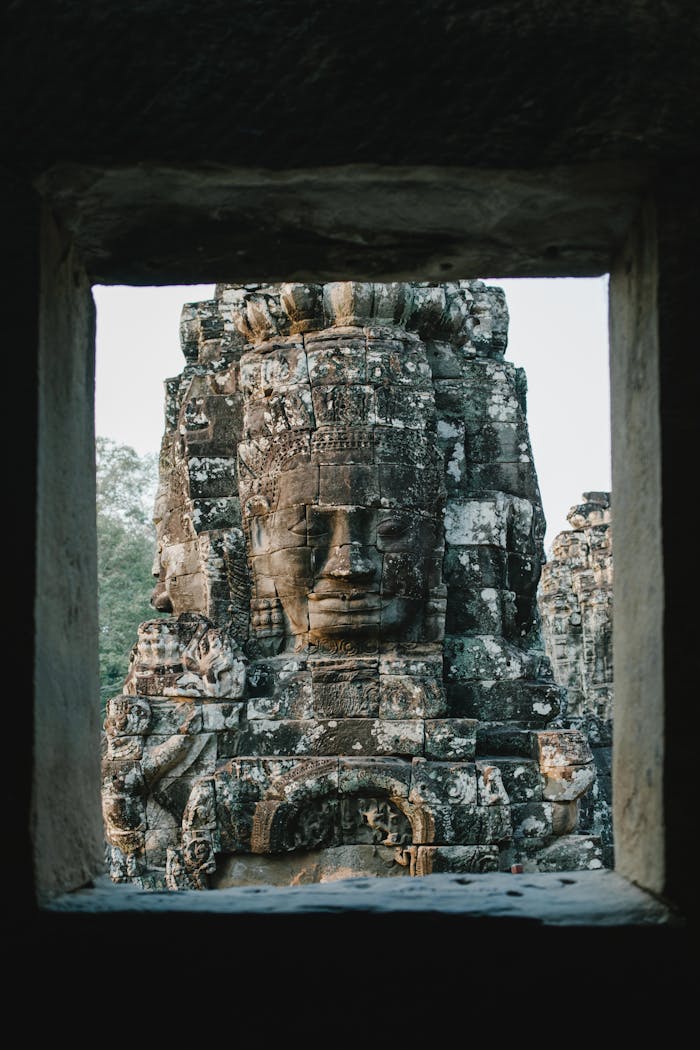
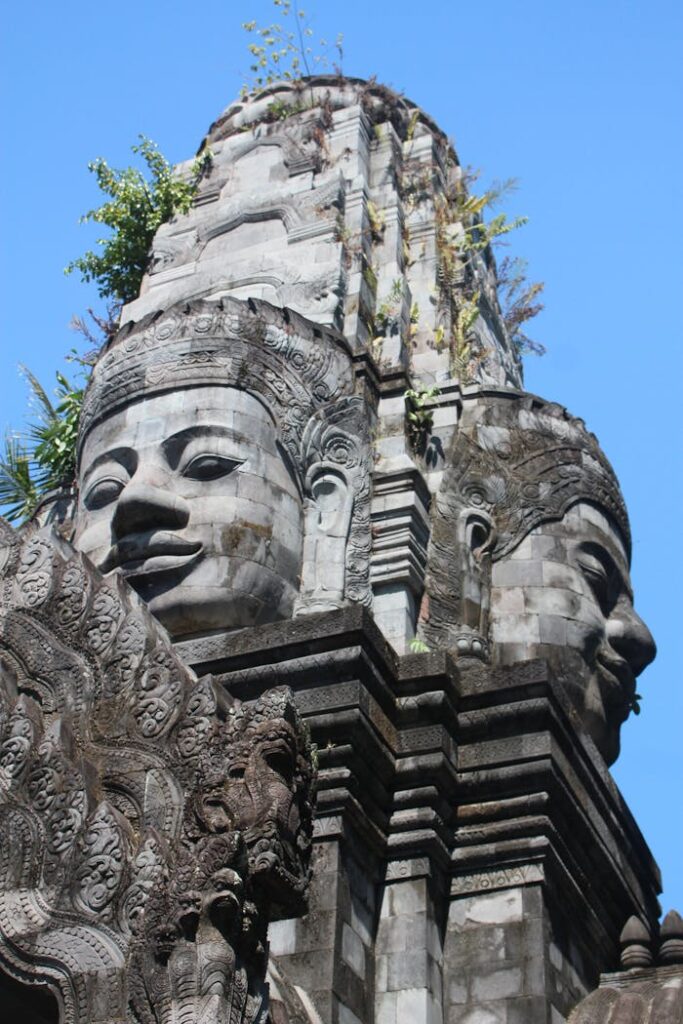
In this amazing temple complex in Cambodia, a face is repeated over and over and over again in sets of four. We are in a Buddhist land, but are they Buddhist in origin?
A Confluence of Religions
ayon Temple, nestled within the Angkor Wat complex in Cambodia, stands as an architectural marvel and a testament to the rich cultural and religious history of the Khmer Empire. Constructed in the late 12th or early 13th century under King Jayavarman VII. Bayon was dedicated to the Hindu God, Brahma is always represented with four faces, facing four directions. But then the temple was dedicated to Mahayana Buddhism and the faces were interpreted to be ever locate this for us in the facial form of king Jayavarman VII. It came to encapsulate a blend of spiritual influences.The temple’s intricate bas-reliefs depict vivid scenes of historical events, daily life, and mythological narratives, providing a window into the societal and cultural fabric of the Khmer Empire.This transition did not occur in isolation but was part of a broader pattern of religious syncretism, where Hindu and Buddhist elements often coexisted and influenced each other.
Worship of Brahma in Early Khmer History
In the context of early Khmer history, the worship of Brahma, the Hindu god of creation, held a crucial place alongside the veneration of Shiva and Vishnu. Brahma, often depicted with four faces and four arms, symbolized the cosmic order and the creation of the universe. In Khmer temples, including those that preceded Bayon, Brahma was frequently represented in bas-reliefs and statuary, underscoring his importance in the Hindu cosmology embraced by the Khmer kings.
The reverence for Brahma in Khmer history is reflective of the broader Indian influence on Southeast Asia during the early centuries of the Common Era. Indian traders and scholars brought with them not only goods but also religious texts and practices, which were adopted and adapted by local rulers. This cultural exchange facilitated the integration of Hindu deities into the Khmer religious framework, where they were worshipped alongside indigenous spirits and ancestors.
Meditations for Modern Seekers at Bayon
Bayon Temple, with its rich history and spiritual ambiance, offers a profound setting for both historical exploration and personal reflection. Through mindful engagement and meditation, modern visitors can connect with the temple’s legacy and find inspiration in its timeless beauty and tranquility.
For modern seekers visiting Bayon Temple, meditative practices can enhance the spiritual experience and provide deeper insights into the temple’s historical and cultural significance. Here are a few meditative approaches that can be particularly meaningful:
1.  Mindfulness Meditation: Sitting in the shadow of the towering faces, one can practice mindfulness meditation, focusing on the breath and the present moment. The serene expressions of the stone faces can serve as a focal point, helping to cultivate a sense of peace and presence.
2.  Contemplative Walking: The temple’s layout, with its labyrinthine corridors and expansive terraces, is ideal for contemplative walking. Slowly navigating the pathways while observing the intricate carvings and the play of light and shadow can deepen one’s connection to the site and its history.
3.  Visualization Meditation: Engaging in visualization meditation, one can imagine the temple in its prime, bustling with monks, worshippers, and royal processions. This exercise can foster a sense of continuity with the past and appreciation for the temple’s enduring legacy.
4.  Loving-Kindness Meditation: Inspired by the compassionate gaze of the faces, one can practice loving-kindness meditation, sending thoughts of goodwill and compassion to oneself and others. This practice resonates with the temple’s Buddhist dedication and its emphasis on compassion.